



Agriculture can create large numbers of productive jobs for Africa’s young people, but only when programmes move beyond training youth to farm. A robust employment model must connect skills, productive resources, finance, technology, infrastructure and reliable markets across the entire agricultural value chain.
The challenge is not participation alone
Agriculture remains an important source of work for young people in countries such as Ghana and Uganda. Yet participation does not automatically translate into decent employment. Many young people work informally, earn unstable incomes, lack access to productive assets and remain exposed to climate, market and price risks.
Youth programmes therefore need to focus on the quality, productivity and sustainability of work—not simply the number of young people entering agriculture. The goal should be viable pathways into wage employment, service businesses, processing, technology, logistics and growth-oriented agribusiness.
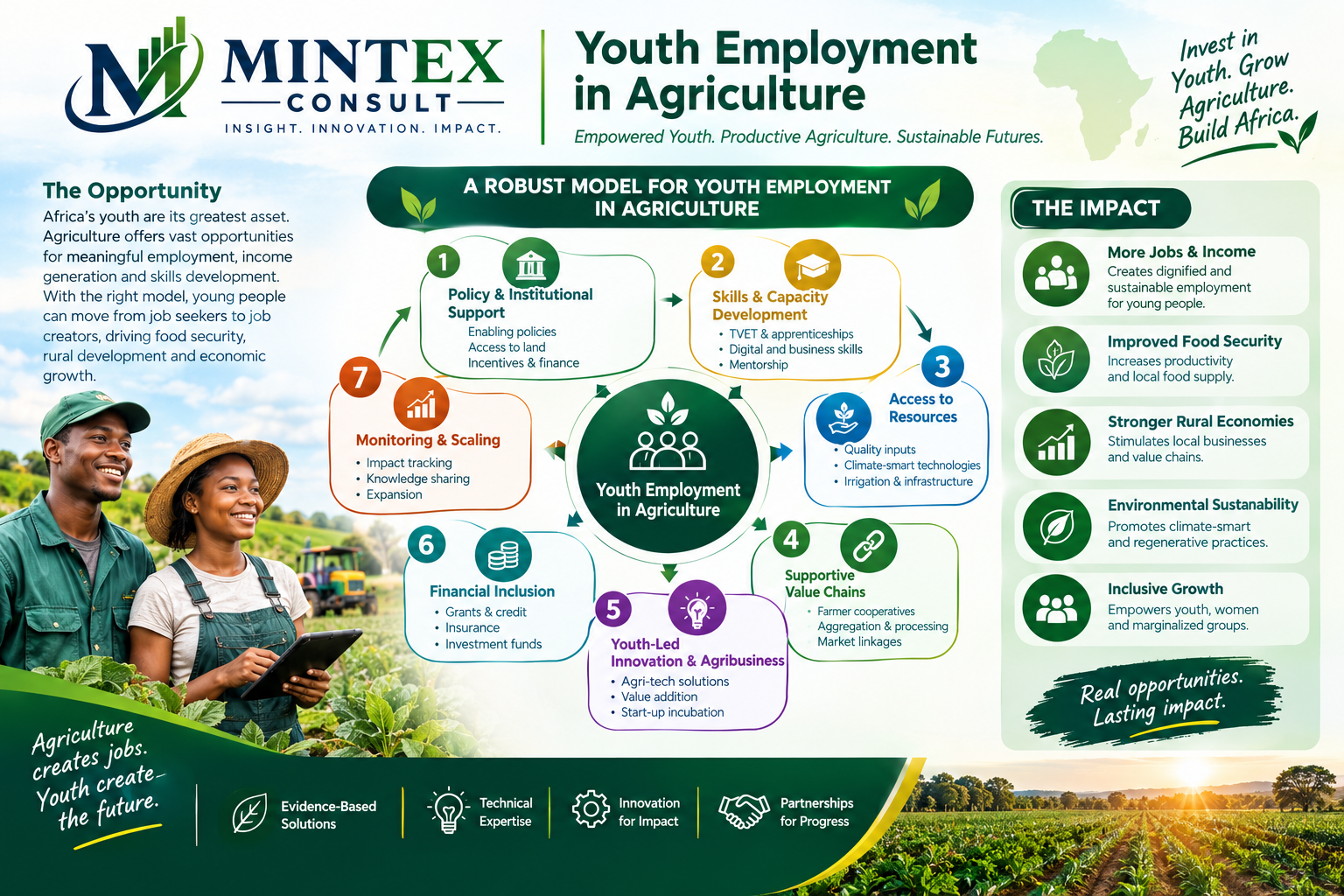
A systems model for youth employment
1. Supportive policy and institutions
Youth employment strategies need clear institutional ownership and coordination across agriculture, employment, education, trade, local government and finance. Policies should address barriers to land, infrastructure, licensing, procurement and market access while recognising the different needs of young women, rural youth, persons with disabilities and other underserved groups.
2. Market-led skills development
Training should respond to real value-chain demand. Technical and vocational education, apprenticeships and mentorship need to combine production skills with digital agriculture, financial literacy, business management, quality standards, climate-smart practices and customer development. Practical exposure matters as much as classroom instruction.
3. Access to productive resources
Skills cannot generate employment without land, water, quality inputs, equipment, storage, energy, connectivity and information. Shared-service models can make machinery, irrigation, cold storage and processing facilities accessible to young enterprises that cannot afford to own them individually.
4. Strong agricultural value chains
Youth enterprises need dependable links to aggregation, processing, storage, transportation, certification, buyers and markets. Programmes should begin with market demand and work backwards to production rather than train participants first and search for customers later. Off-take agreements and transparent quality requirements can reduce uncertainty and guide investment.
5. Youth-led agribusiness and innovation
Young people should be supported to participate beyond primary production. Opportunities exist in mechanisation services, input supply, seed systems, irrigation, aggregation, cold-chain management, agro-processing, logistics, agricultural technology, extension, marketing, finance and data services. These activities can offer higher value and more diverse career pathways.
6. Appropriate finance and risk management
Agricultural enterprises have seasonal cash flows and risks that conventional lending often does not accommodate. Young entrepreneurs need suitable credit, grants, guarantees, insurance, investment funds and blended-finance arrangements. Financial support should be paired with business coaching, records management and realistic repayment structures.
Climate resilience and digital opportunity
Climate variability makes resilience central to youth employment. Water management, diversified production, soil health, suitable varieties, weather information and insurance can protect enterprises and jobs. Digital tools can improve access to prices, advisory services, finance, input suppliers and customers, but technology must solve a defined business problem and remain usable in local conditions.
Measure employment quality and enterprise survival
Effective monitoring, evaluation and learning should go beyond counting trainees or enterprises launched. Programmes need to track whether employment and businesses survive, whether incomes and productivity improve, and whether opportunities are inclusive and environmentally sustainable.
- Number and quality of jobs created or sustained.
- Changes in income, productivity and business revenue.
- Enterprise survival and growth after support ends.
- Participation and outcomes for women and marginalised youth.
- Access to finance, productive assets and markets.
- Adoption of climate-smart and resource-efficient practices.
- Strength and durability of buyer and value-chain relationships.
From beneficiaries to market actors
The central principle is straightforward: invest in young people across the whole agricultural value chain—not only as farmers, but as entrepreneurs, innovators, service providers, processors, technicians and market actors. When policy, skills, finance and markets work together, agriculture can support stronger rural economies, better food systems and more resilient livelihoods.
Mintex Consult supports agricultural and youth-employment programmes through project design, baseline and endline studies, monitoring and evaluation, research, data analysis and technical advice. Contact our team to develop or evaluate a youth-employment model.
