



Enzyme technology can help African paper manufacturers improve fibre recovery, reduce energy and chemical consumption, strengthen recycling and make better use of locally available agricultural residues. Its value lies in targeted biological action that supports both production efficiency and environmental performance.
By Francis Dadzie Mintah
Why enzyme technology matters
Paper making is resource-intensive. It requires fibre, water, energy and chemicals during pulping, bleaching, refining and recycling. Enzymes provide a selective way to modify lignin, hemicellulose, cellulose, pectin, pitch and adhesive contaminants. Their action can be controlled through dosage and operating conditions, allowing mills to improve particular process steps without the severity associated with some conventional treatments.
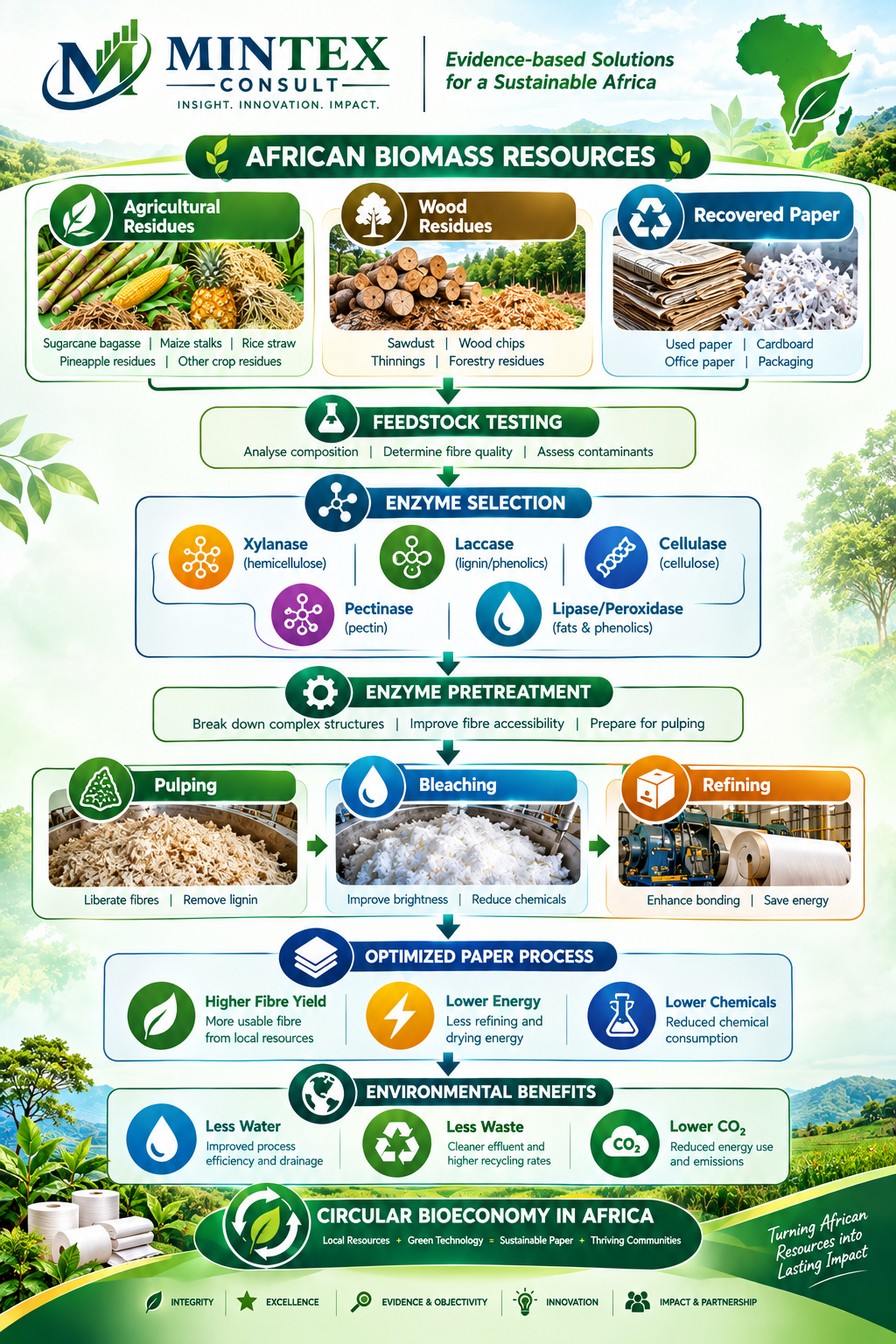
Key enzymes and their applications
Xylanases in pulping and bleaching
Xylanases act on hemicellulose and can make lignin more accessible during bleaching. Xylanase-assisted bleaching may improve pulp brightness and reduce the severity or quantity of bleaching chemicals required. This can lower chemical costs and reduce the pollutant load entering wastewater-treatment systems.
Cellulases in refining and recycling
Carefully controlled cellulase treatment can modify fibre surfaces, support drainage and improve refining efficiency. In recycled-paper operations, cellulases can assist deinking and fibre recovery. Dosage must be optimised because excessive activity may weaken fibres and reduce paper strength.
Laccases for lignin modification
Laccases can support lignin modification and biobleaching applications. Their potential is especially relevant where mills want to reduce dependence on harsh chemical treatments while maintaining acceptable brightness and product quality.
Pectinases and lipases for process cleanliness
Pectinases can help remove pectic substances that interfere with processing, while lipases can reduce pitch deposits originating from wood resins and recovered-paper contaminants. Better deposit control supports machine performance, product quality and production continuity.
A circular bioeconomy opportunity for Africa
Africa has substantial quantities of agricultural residues that can serve as alternative fibre sources. Sugarcane bagasse, maize stalks, rice straw, pineapple residues, bamboo and other non-wood materials can supplement recovered paper and conventional pulp. Productive use of these resources can reduce agricultural waste, diversify raw-material supply and create value closer to farming communities.
The opportunity extends beyond fibre. Some agricultural residues may also serve as substrates for microbial fermentation to produce industrial enzymes. This creates a circular model in which local biomass supports both paper production and the biological inputs used to improve that production.
Environmental and operational benefits
- Improved fibre liberation and recovery, with potential reductions in fibre loss.
- Lower chemical consumption during selected pulping and bleaching operations.
- Reduced refining energy while maintaining required paper properties.
- Improved deinking and contaminant control in recycled-paper production.
- Lower wastewater pollutant loads and improved water efficiency.
- Reduced energy use and associated greenhouse-gas emissions.
- More productive use of agricultural residues and recovered paper.
Successful adoption requires testing
Enzymes are not universal drop-in solutions. Performance depends on enzyme type, activity, dosage, pH, temperature, processing time, fibre characteristics and the chemicals already present. The same treatment may produce different results across mills or feedstocks.
Implementation should begin with laboratory characterisation and controlled trials. Pilot studies can measure pulp yield, brightness, drainage, strength, chemical savings, energy use, wastewater quality and total operating cost. Techno-economic analysis and life-cycle assessment help determine whether laboratory improvements translate into commercially and environmentally meaningful gains.
Mintex Consult’s technical approach
Mintex Consult has supported paper-making companies across Africa with enzyme-based approaches aimed at improving process performance and environmental sustainability. Our work combines laboratory testing, process optimisation, pilot trials, data analysis and technical advice so that each application is tailored to the mill, feedstock and production objective.
To evaluate enzyme applications for your mill or fibre source, contact Mintex Consult.
