


Artificial intelligence is changing project management from a largely reactive reporting function into a predictive, learning-oriented discipline. When it is governed responsibly, AI can help project teams identify risks earlier, use resources more effectively and make faster, evidence-based decisions.
By Francis Dadzie Mintah
From reporting the past to anticipating the future
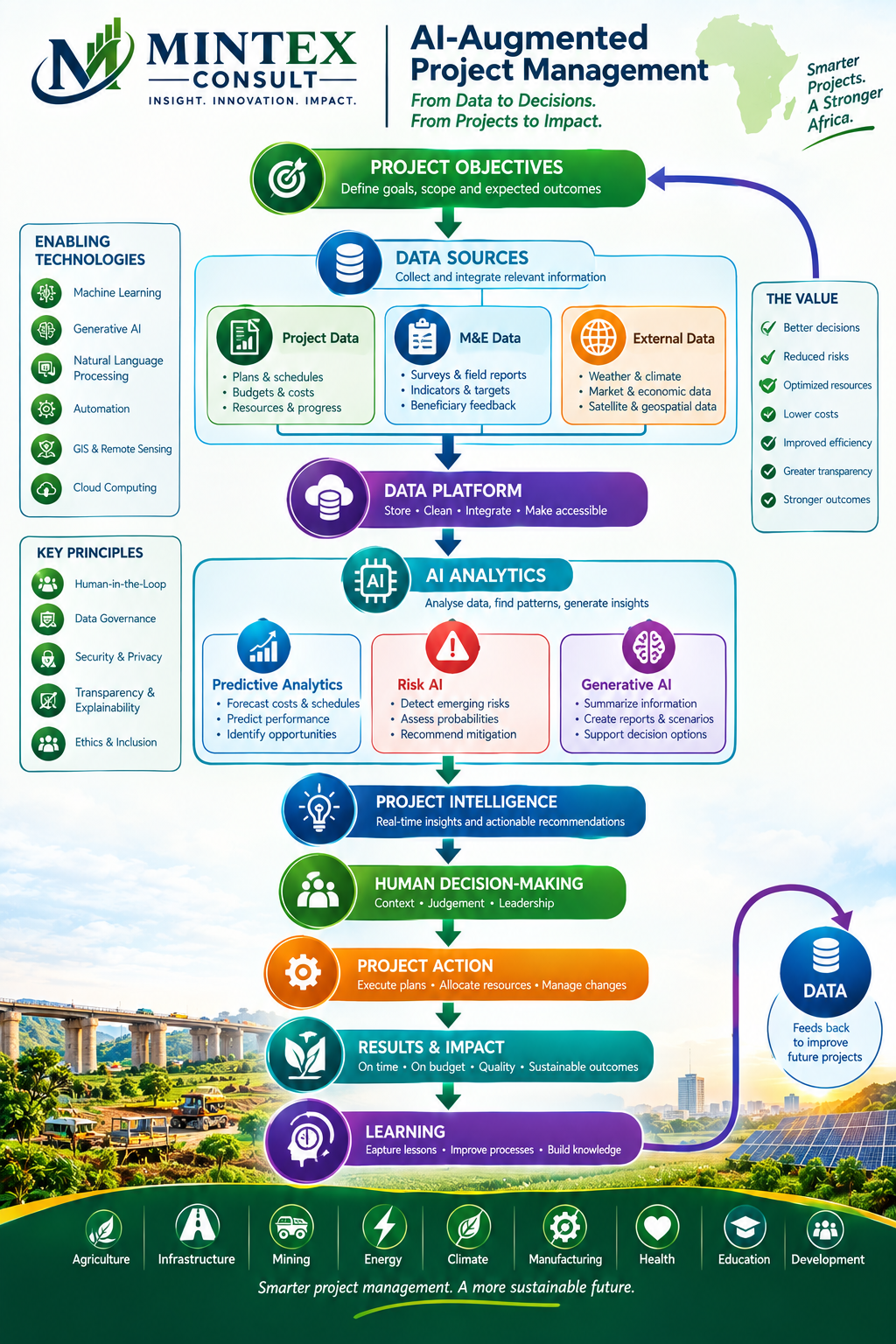
Traditional project management depends on planning, implementation, monitoring, reporting and corrective action. This remains essential, but many projects generate more information than teams can analyse quickly. AI-augmented project management adds predictive analytics, machine learning, generative AI, natural-language processing and intelligent automation to help convert that information into timely insight.
Traditional cycle: Plan → Implement → Monitor → Report → Correct
AI-augmented cycle: Collect → Analyse → Predict → Decide → Act → Learn
Where AI creates value across the project lifecycle
Planning and scenario development
AI can analyse historical delivery data, project assumptions, resource constraints and external conditions to support more realistic plans. Scenario models allow managers to compare possible schedules, budgets and implementation strategies before committing resources. The purpose is not to produce a perfect forecast, but to expose assumptions and improve preparedness.
Cost and schedule forecasting
By tracking progress patterns, expenditure, procurement timelines and milestone performance, predictive models can flag emerging delays or cost pressures earlier than periodic reports. Early-warning signals enable managers to investigate the causes, test corrective options and act before small deviations become major problems.
Risk and issue management
AI tools can review structured registers, field reports, meeting records and operational data to identify recurring issues and changing risk patterns. Natural-language processing can help organise large volumes of narrative information, while predictive models can estimate the likelihood and potential impact of selected risks.
Resource optimisation
Projects frequently balance limited staff, equipment, finance and time across competing activities. AI-supported optimisation can help teams compare allocation options, identify underused resources and align deployment with priority tasks. Final decisions should still account for local knowledge, staff welfare and stakeholder commitments.
Reporting and knowledge management
Generative AI can assist with first drafts of progress reports, meeting summaries, action trackers and management briefs. Automation reduces repetitive administrative work and helps teams retrieve decisions and lessons from dispersed records. Every output must be checked against the underlying evidence before it is shared or used for a consequential decision.
Strengthening monitoring and evaluation
In monitoring and evaluation, AI can combine survey data, field observations, financial information, satellite imagery, geographic information and performance indicators. This makes it possible to detect anomalies, compare locations, forecast implementation challenges and focus verification on areas where results differ from expectations.
Used well, these capabilities improve adaptive management. Teams can learn during implementation instead of waiting until an endline study to discover what worked, what did not and why. AI does not replace sound indicators, field engagement or evaluation judgement; it increases the speed and scale at which evidence can be examined.
Human oversight remains essential
AI should augment project managers rather than replace them. Projects operate within political, cultural, environmental and organisational contexts that models may not fully understand. Human leaders remain responsible for interpreting evidence, consulting stakeholders, validating recommendations, managing trade-offs and maintaining accountability.
- Data quality: inaccurate or incomplete data will produce unreliable conclusions.
- Bias and fairness: models should be tested for outcomes that disadvantage particular groups.
- Privacy and cybersecurity: personal and confidential project information must be protected.
- Explainability: decision-makers should understand the evidence and assumptions behind recommendations.
- Validation: AI-generated analysis and text require professional review.
- Capacity: staff need the skills to use AI critically, not simply accept its outputs.
The opportunity for African projects
AI-augmented project management has strong potential in agriculture, infrastructure, mining, energy, climate programmes, carbon markets, manufacturing and development initiatives. It is especially valuable where projects cover dispersed locations, depend on complex supply chains, involve multiple partners or carry extensive reporting requirements.
The practical starting point is not the purchase of a complex platform. Organisations should first define their management questions, assess available data, strengthen governance and identify a focused use case with measurable value. Pilot implementation can then test accuracy, usability, cost and organisational readiness before wider adoption.
Mintex Consult’s approach
Mintex Consult brings together project management, monitoring and evaluation, predictive analytics, GIS and remote sensing, and applied AI. This integrated approach—AI-Augmented Project Intelligence—helps organisations turn project data into better decisions, stronger performance and measurable impact.
To explore a responsible AI application for your programme or portfolio, contact Mintex Consult.
