



Africa is entering a decisive phase in the development of carbon markets. With stronger data systems and predictive analytics, project developers, investors and regulators can move from assumptions to evidence-based decisions—improving integrity, managing risk and directing finance towards high-impact climate action.
By Francis Dadzie Mintah
A growing opportunity for Africa
Carbon markets can mobilise additional finance for renewable energy, clean cooking, forestry, agriculture, waste management, industrial decarbonisation and other low-carbon activities. The Africa Carbon Markets Initiative has highlighted the continent’s considerable potential and set an ambition of producing approximately 300 million carbon credits annually by 2030, alongside wider objectives for investment, employment and fairer distribution of carbon-market revenues.
Yet carbon markets are fundamentally data-dependent. Across many African markets, relevant datasets remain fragmented, inconsistent, difficult to access or relatively immature. These gaps affect project design, carbon estimation, pricing, verification and risk assessment. Predictive analytics offers a practical way to organise available evidence, identify patterns and make better-informed forecasts.
What is predictive analytics?
Predictive analytics combines historical and real-time data with statistical techniques, econometric models, machine learning, artificial intelligence and geospatial information to estimate what is likely to happen in the future. It does not eliminate uncertainty. Instead, it makes uncertainty measurable and helps decision-makers compare possible outcomes.
Historical data + current information + statistical or AI models → forecast → probability or risk estimate → decision
Questions predictive analytics can answer
Mintex Consult applies predictive analytics to practical questions across the carbon-market value chain, including:
- What is likely to happen to the price of a carbon credit?
- Which carbon projects are most likely to generate the expected volume of credits?
- How much carbon could a forest, restoration or agroforestry project sequester?
- What is the probability that a project will underperform its expected carbon yield?
- Which projects face elevated leakage, reversal or non-permanence risks?
- Which types of carbon credits are most likely to attract buyers?
- When should a developer sell, hold or contract its credits?
- How could changes in regulation or Article 6 rules affect market value?
- Which projects present elevated integrity, verification or financial risks?
Turning data into market intelligence
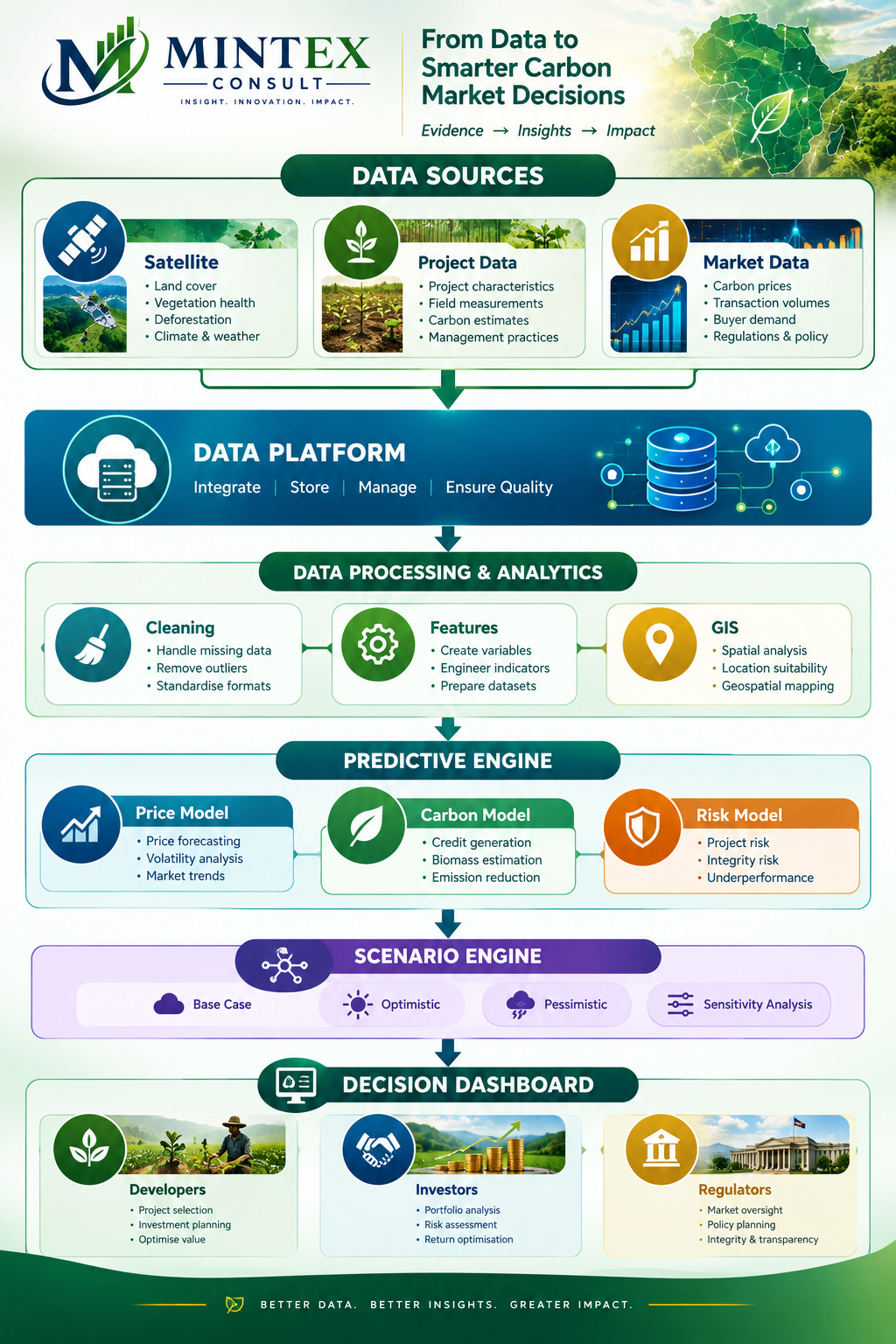
A robust predictive system begins by integrating different sources of information. Satellite imagery can show land-cover change, vegetation health, deforestation and climate conditions. Project-level records provide field measurements, carbon estimates and management practices. Market data contributes carbon prices, transaction volumes, buyer demand and regulatory developments.
Once brought into a secure data platform, the information is cleaned, standardised and checked for quality. Analysts can then engineer indicators, conduct spatial analysis through geographic information systems and develop models for price forecasting, carbon-credit generation and project risk. Scenario analysis—such as base-case, optimistic, pessimistic and sensitivity scenarios—helps users understand how changing assumptions could affect results.
The final output should be decision-ready rather than merely technical. Dashboards can help developers compare projects and optimise value, assist investors with portfolio and risk analysis, and support regulators with market oversight, policy planning, transparency and integrity.
Applications across the carbon-market lifecycle
Project identification and feasibility
Predictive models can combine environmental, social, financial and geospatial indicators to identify locations and project types with strong mitigation potential. This supports earlier screening and helps developers direct resources towards opportunities with a credible pathway to implementation.
Carbon estimation and performance monitoring
For nature-based and land-use projects, models can estimate future sequestration, monitor vegetation trends and flag deviations from expected performance. For energy, waste and industrial projects, analytics can compare projected and observed reductions, improving planning and monitoring, reporting and verification.
Pricing and commercial strategy
Carbon-credit value is influenced by project type, methodology, vintage, geography, co-benefits, buyer preferences, market liquidity and policy developments. Predictive analytics can help organisations examine how these variables interact and develop more realistic pricing, contracting and portfolio strategies.
Integrity and risk management
High-integrity markets require credible additionality, permanence, transparent benefit sharing and reliable verification. Risk models can help identify projects that warrant closer review and support targeted due diligence without replacing professional judgement or independent validation.
Article 6 and the evolving policy landscape
Article 6.2 of the Paris Agreement allows countries to cooperate through bilateral and other approaches, including transfers of Internationally Transferred Mitigation Outcomes. African countries are increasingly developing the legislation, registries, approval processes and institutional arrangements required to participate in voluntary and compliance carbon markets.
Ghana has advanced its international carbon-market framework and reported significant authorised mitigation outcomes. Kenya has likewise established a legal and institutional framework through its Climate Change (Carbon Markets) Regulations, 2024, including provisions for project approval, verification, benefit sharing and a national registry. As these systems mature, predictive analytics can help market participants assess regulatory scenarios, authorisation risks and the possible implications of corresponding adjustments.
Building Africa’s analytical infrastructure
The growing sophistication and digitalisation of carbon markets makes predictive analytics increasingly important. Machine learning, deep learning, natural-language processing and geospatial techniques are already being applied to climate-finance and carbon-market problems, although much of the empirical research remains concentrated in larger, data-rich markets.
For Africa, the opportunity extends far beyond forecasting carbon prices. The greater value lies in creating dependable analytical infrastructure for the entire carbon-market value chain—from project identification and carbon estimation to risk assessment, pricing, trading, monitoring, reporting and verification, and impact assessment.
From better data to greater impact
Predictive analytics will not substitute for strong methodologies, credible field data, transparent governance or independent verification. Used responsibly, however, it can improve the speed, consistency and quality of decisions while revealing where uncertainty remains. This is essential for building African carbon markets that are investable, transparent and capable of delivering genuine climate and development outcomes.
Mintex Consult supports organisations with research, data analytics, project design, monitoring and evaluation, and technical advisory services. To discuss how predictive analytics can strengthen your carbon-market strategy or project, contact our team.
